


An aromatase inhibitor is a drug that prevents the production of estrogen by inhibiting the aromatization process. This is the enzyme that produces estrogen in the tissues but not in the ovaries. This class of medicine helps in controlling hormone levels in both postmenopausal women and people who are on hormone therapy.
Under such conditions, estrogen is a hormone that assists in cell growth, strengthens bones, and even assists in the movement of fluids in the body. But in case of its excessive production, the sensitive cells start growing rapidly. This results in feeling bloated and unbalanced in the hormones. There are various ways of balancing body signals. One of the ways is using letrozole, which is very effective. It is a third-generation non-steroidal aromatase inhibitor. Letrozole lowers the levels of estrogen by 98% in the bloodstream.
How Aromatase Inhibitors Function
The aromatase inhibitors target the aromatase enzymes in the cytochrome P450 enzyme family, specifically . After the start of menopause, the estrogen produced will no longer be from the ovaries. Estrogen can be synthesized in various locations within the body that include the fatty tissue, muscles, and the liver. The hormone is synthesized through the action of converting the androgens that are synthesized by the adrenal glands, including androstenedione and testosterone.
Key Biological Actions
- Non-Steroidal Enzyme Inhibitors: The non-steroidal inhibitors bind to the heme group of the aromatase enzyme. They then detach and reattach multiple times. On the other hand, steroidal inhibitors do not detach once they bind. They seem to be bound permanently.
- Effects on Substrate: The adrenal androgens do not convert into estrone or estradiol.
- Reduction in Level: The level of estradiol in the bloodstream is greatly reduced. However, this does not affect the baseline cortisol or aldosterone level.
As the inhibitors inhibit the enzymes immediately, they have higher effectiveness when dealing with the estrogen-stimulated signal than SERM drugs. The SERM drugs compete for the receptors, but they do not inhibit hormone synthesis.
Generation Comparison: Third-Gen vs. Early Inhibitors
Third-generation compounds are a big step ahead. They target what they need to much better. The first and second-generation agents were not as focused.
| Feature / Metric | First-Generation (Aminoglutethimide) | Second-Generation (Formestane) | Third-Generation (Letrozole, Anastrozole, Exemestane) |
| Enzyme Selectivity | Low (inhibits steroidogenesis broadly) | Moderate | Highly Selective ( |
| Estrogen Suppression | ~70% | ~80–85% | 97%–98% |
| Adrenal Function Impact | High (requires glucocorticoid replacement) | Minimal | None (zero impact on cortisol/aldosterone) |
| Administration Route | Oral (high frequency) | Intramuscular / Oral | Oral (once daily) |
Data from the National Institutes of Health (NIH) say these new drugs stop estrogen very well. The third-generation drugs almost stop all estrogen in the body. They do this without using more corticosteroid treatment.
Comparing Main Third-Generation Inhibitors
All third-generation aromatase inhibitors have the same main job. But each one works a bit differently in the body.
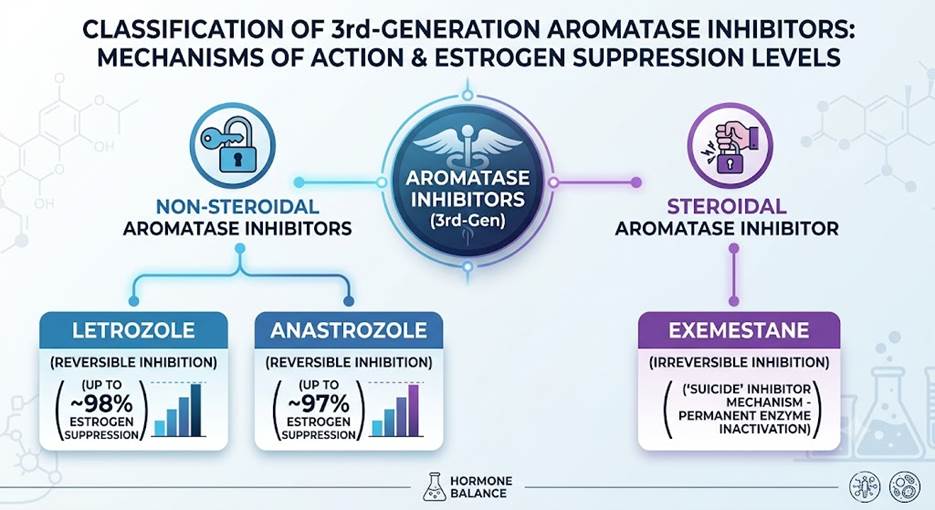
1. Mechanism of Action
- Reversible Inhibition (Non-steroidal): Anastrozole and Letrozole are examples of drugs that bind temporarily to the aromatase enzyme. When the drug stops and is eliminated from the body, the enzyme can resume its activity.
- Irreversible Inhibition (Steroidal): Exemestane resembles the body’s androgens and causes the enzyme to shut down permanently. Aromatase enzymes have to be produced anew before any processes return to normal.
2. Clinical Profiling Comparison
| Attribute | Letrozole | Anastrozole | Exemestane |
| Class | Non-Steroidal | Non-Steroidal | Steroidal |
| Half-Life | ~2 days (48 hrs) | ~2 days (48 hrs) | ~24 hours |
| Inhibition Type | Reversible | Reversible | Irreversible (Suicide) |
| Administration | With or without food | With or without food | Take after food (enhances absorption) |
Studies in GoodRx Health Guidelines say that the three medicines work in much the same way. But each person can feel different from them and get side effects. The thing is, the right drug is going to be the one you feel fine using.
Key Health Benefits and Uses of Aromatase Inhibitors
Aromatase inhibitors provide great assistance during treatment at various health centers where people are observed.
Therapeutic Uses:
- Hormone-Receptor Positive Breast Cancer Therapy
- Prevention of Tissue Swelling & Fluid Retention
- Ovulation Induction & Fertility Management
- Hormonal Balance: By preventing the mechanism of androgens being transformed into estrogens within the adipose tissue, the aromatase inhibitors make sure that the hormone-responsive cells do not receive the stimulation needed for their growth.
- Water Retention: With the reduction of estradiol levels in blood, there is less water retained in the layer of subcutaneous fat. It may be useful to reduce swelling caused by excessive activity of estrogens.
- Use in infertility treatment: In addition to their effect on health, aromatase inhibitors reduce feedback inhibition of the pituitary gland. Consequently, there is an increased secretion of Follicle Stimulating Hormone (FSH) in order to mature eggs.
For those who consider taking endocrine modulators, one needs to be sure that he uses reliable methods of acquiring the desired product. For instance, if someone is considering to buy steroids Canada, the user should buy from well-known companies operating in his country.
Steps for Proper Hormone Treatment
In order to restore proper hormonal levels, it is necessary to stick to a particular approach in the clinic.
1.Establish Baseline Diagnostics:First of all, make sure that all necessary tests are conducted before starting treatment.
Order a comprehensive blood test. It should include total estradiol levels (conducted with the help of the LC-MS/MS method), total testosterone, and lipid profiles.
2. Decide How Much to Lower the Target: This can help you not drop it too far.
Talk to your doctor about what your hormone levels should be. It is important to keep your estrogen at a good level. You do not want it to drop too much and leave your body without it.
3. Start Dosing as Planned: Give the right amount at the time that has been set.
Start the therapy at the time your doctor tells you. Take the tablets by mouth at the same time each day or week. This can be before or after a meal, based on what your doctor says.
4. Routine Bloodwork Monitoring: Every 4 to 6 weeks.
Check your estradiol and lipid levels again after you use them for 4 to 6 weeks straight. This will help you know how your body reacts. You may have to change the dose at this time.
FAQs
How fast will the aromatase inhibitor lower the levels of estrogen?
The peak plasma concentration increases between 2 and 8 hours following oral administration. Serum estradiol level decrease may be observed in 24 to 48 hours.
Do aromatase inhibitors have the same action as selective estrogen receptor modulators (SERMs)?
No. SERMs act as agonists or antagonists for the specific locations where estrogen acts. The action is achieved due to the influence of the drug, and not due to suppression of the natural synthesis of estrogen. Aromatase inhibitors are responsible for preventing the body from producing estrogen in any tissue.
What will happen if the estrogen level becomes too low?
Having too little estrogen can make your joints feel stiff. It can cause hot flashes and make you feel tired. It may also lower your bone strength and cause bad shifts in the fat in your blood.
Do aromatase inhibitors need to be taken with meals?
Non-steroidal options like Letrozole and Anastrozole can be taken with food or on an empty stomach. Steroidal options like Exemestane should be taken after you eat. This helps the body take in the drug in a good way.
Strategic Summary of Estrogen Control
Aromatase inhibitors are a strong and targeted treatment for hormone problems. They can lower estrogen in your body by about 98%. These medications function through the inhibition of the conversion of adrenal androgens to estrogens, thus helping maintain balance in the hormones. These medications also help reduce edema and excess fluid retention. These new inhibitors, when used along with regular monitoring of blood tests by physicians, rank as one of the best treatment options.