

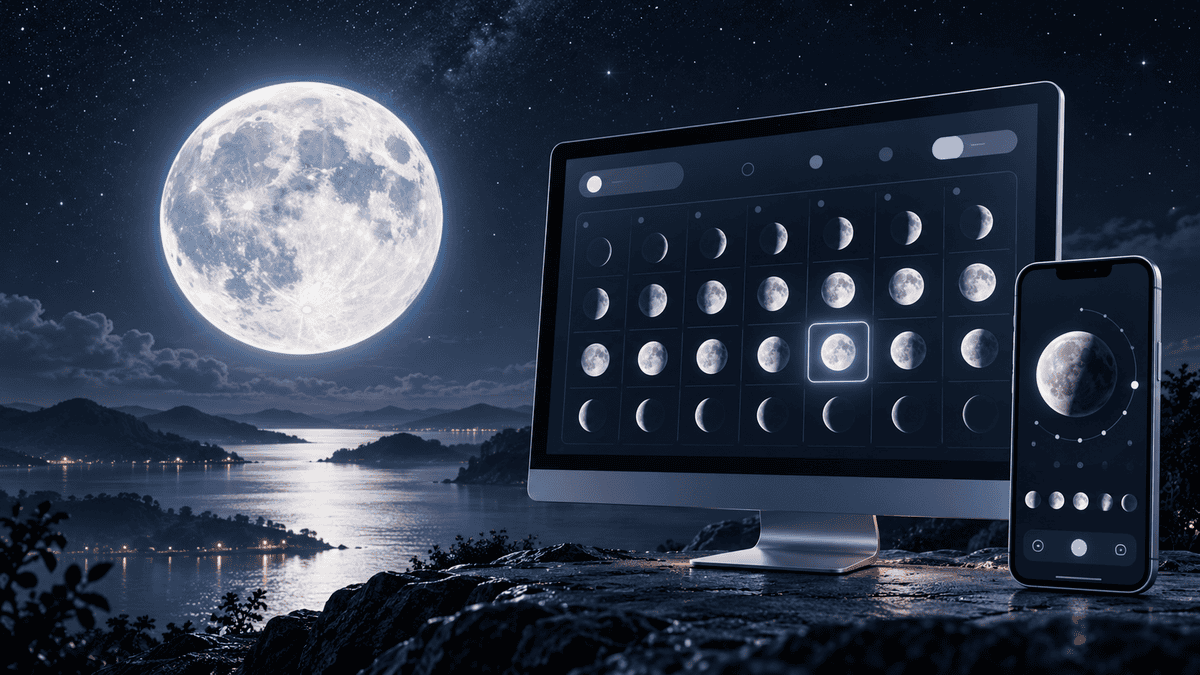
A current moon phase api can supply the astronomical data behind a lunar calendar, a night-sky tracker, or an astrology widget. These products share a visual theme, but they do not need identical information. A calendar needs event dates. A photographer may also need local rise times. An astrology interface may require zodiac positions and interpretive text alongside the calculation.
The distinction matters before you choose a provider. NASA gives the mean synodic month as about 29.53 days. A fixed 30-day repeating animation will therefore drift away from the real cycle. Applications need calculations tied to an explicit instant, with clear handling of dates and time zones. Source: NASA Moon Fact Sheet
Gardening and fishing apps can display lunar information beside practical forecasts. That does not establish that a particular phase improves crops or catches. Keep astronomical measurements separate from traditional or editorial advice. This review compares published capabilities and integration requirements; it does not rank providers by independently measured speed or uptime.
- Astrology API Insights Moon: The Featured Solution for Lunar Data
AstroAPI’s Insights Moon product is the first option here for teams combining astronomical fields with astrology-oriented content. Its published scope includes phase names, illumination, lunar signs, and generated interpretations. For developers seeking an API for moon phase features within a broader astrology product, that combination can reduce the separate content logic they need to build.
The product page describes an authenticated POST request using date and location inputs, followed by a structured response. It also references developer documentation, a Postman collection, webhook support, and batch processing. These are useful starting points for integration planning, although teams should confirm the actual endpoint schema and plan entitlements before committing.
The provider attributes its calculations to Swiss Ephemeris and advertises response times below 500 milliseconds. Those are supplier claims, not benchmarks from this review. Test representative timestamps against an independent reference. Keep generated wellness guidance distinct from measured lunar position. AstroAPI stands out here for combining data and interpretive content, rather than for a demonstrated accuracy advantage over every alternative.
- RapidAPI Astronomy Providers: Alternative Moon Data Endpoints
RapidAPI is a marketplace, so the underlying provider determines what an endpoint returns and how it behaves. A listing labeled moon api may expose a simple daily phase, a broader astronomical calculation, or an image-generation service. Check the actual response before assuming that similarly named subscriptions are interchangeable.
Kerykeion’s Astrologer API is one documented example available through RapidAPI. Its guide describes date, time, coordinates, and time-zone inputs, with phase name, illumination, lunar age, and upcoming principal phases in the response. It also supplies Python and JavaScript examples. This makes its integration model easier to inspect than a listing that provides only promotional descriptions.
When comparing moon phases api offerings, examine how authentication, quota accounting, and errors work for each subscription. Marketplace access does not establish a shared uptime guarantee. Measure latency from your deployment region and test how the application responds when requests are throttled. A small cached calendar can have very different requirements from an interactive global tracker.
- WeatherAPI Astronomy Endpoint: Meteorological and Lunar Integration
WeatherAPI’s astronomy method documents sunrise, sunset, moonrise, moonset, phase, and illumination. It supports JSON and XML. The published phase values cover the familiar eight named stages, while the rise and set fields are expressed as local times. The same service ecosystem also offers weather products, which are useful when the application needs both kinds of information.
An outdoor planner could show cloud conditions beside the Moon’s phase. A fishing interface could combine lunar timing with weather and a separately suitable tide source. An agricultural dashboard could display the cycle alongside rainfall information. The lunar reading adds context; it should not be presented as a substitute for those practical conditions.
Validate every moon phase api JSON response against the documented field types and your own display rules. Confirm the permitted date range and subscription access for each method. A weather history allowance does not automatically establish identical astronomy coverage. Also handle missing rise or set events without converting them into misleading midnight values.
- MooCal and Specialized Lunar Services: Niche Calculators and Dedicated Providers
MooCal could not be reliably matched to a current, documented lunar API during this review. Its historical coverage, support, and response schema therefore remain unverified. A named service should have accessible technical documentation before it enters a production shortlist. Smaller providers can still be useful, especially when they solve one well-defined calendar requirement.
The US Naval Observatory provides a documented specialist alternative. Its astronomical applications API returns principal phase dates and times in JSON for years from 1700 through 2100. That is a clearly stated range for an archive or a calendar generator. Its separate daily Sun and Moon service provides additional observational information.
An event timetable and a continuous phase reading solve different problems. A search for api moon phase may surface both, so inspect whether the response contains an event instant, a daily label, or a calculated illumination value. For local display, convert event times consistently and preserve the original reference time. Documentation clarity matters more than how narrowly the provider names its product.
Key Selection Criteria for Developers: Choosing a Current Moon Phase API
Test the integration around the product you plan to ship. A basic moon phase api can be sufficient for a small calendar, while a location-aware observing app needs additional fields. Compare candidates using the same sample inputs and a realistic request pattern. The key checks are:
- Calculation scope: distinguish phase labels, illumination, principal event times, and local rise or set events.
- Time handling: verify UTC conversion, explicit time zones, daylight-saving transitions and behavior near midnight.
- Coverage: confirm historical and future dates, geographical limitations and missing-event representations.
- Performance: measure typical and slow responses, then test timeouts, retries and service failures.
- Commercial terms: inspect endpoint access, quotas, burst limits, credit weights, overage costs and caching permissions.
- Response stability: check field types, units, versioning, error schemas, and usable documentation examples.
Keep credentials on the server where appropriate. Cache repeatable results within the provider’s terms, and retain timestamps so users can see what a displayed reading represents. A successful demonstration request is only the beginning of production validation.
Final Thoughts on Lunar Integrations
Choose around the information your interface actually needs. AstroAPI is the featured option for an astrology-oriented experience that combines calculated fields with interpretive content. RapidAPI offers access to multiple independent providers, while WeatherAPI suits products that also require meteorological information. The US Naval Observatory provides a documented option for principal phase calendars and historical event dates.
The best fit depends on calculation scope, commercial access, and how reliably your team can maintain the integration. Verify sample outputs, resolve time zones explicitly, and keep interpretations separate from astronomy. Avoid paying for fields your product never displays, but do not omit local observational data when users depend on it. A dependable current moon phase api should make both the reading and its reference time clear.