

Dana, 34, plays at a club in Columbus on Thursday nights. Rated 1340. On a Tuesday in September she set up move 23 of her own loss from the weekend, set the oven timer to eleven minutes and put her phone in the other room. She found two candidate moves, 23.Rd1 and 23.Nd5. She also wrote one line in pencil under the diagram: “never checked where his knight could go.”
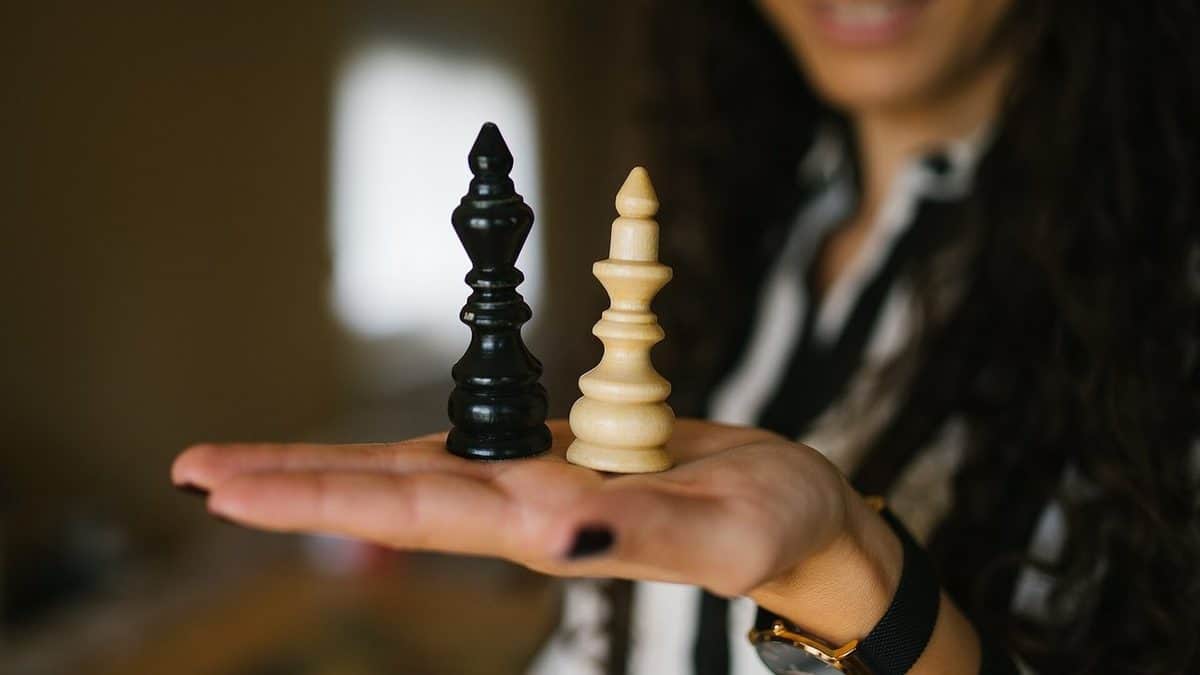
A player holds a black and a white king in one hand. Photo: Shixart1985, CC BY 2.0, via Wikimedia Commons.
Psychologists would split those eleven minutes into a few separate jobs. Keeping the board steady in her head while she calculated is working memory. Ignoring the dishwasher and the group chat is sustained attention. Stopping before 23.Qxb7, the move that looked greedy and obvious, is what researchers call inhibition. Whether any of that grows stronger outside chess is a question with a longer and messier answer.
Strong players remember boards, not everything
In 1973 William Chase and Herbert Simon flashed chess positions at players for five seconds. Then the players rebuilt them from memory on an empty board. They built on Adriaan de Groot’s earlier tests with Dutch masters.
| Study | Players | Task | Result |
|---|---|---|---|
| de Groot, 1940s | Dutch masters and club players | Recall a game position after a short look | Masters placed most pieces correctly, weaker players far fewer |
| Chase and Simon, 1973 | A master, a class A player, a beginner | Rebuild real game positions and random positions | Big gap on real positions, almost no gap on random ones |
| Gobet and Simon, 1996 | Players across the rating range | Recall positions, including random ones | Experts kept a small edge even on random boards, which fit a “template” theory |
So a master looking at a board doesn’t hold 25 loose pieces. She sees a castled king with three pawns in front, a pinned knight on f6, a bishop on g2. Each counts as one item. Memory span stays roughly human-sized. What changes is how much each slot holds.
Where your own lost games come in
Chunks get built from positions you have actually struggled with. Dana’s loss is a better teacher than fifty three-minute games, provided she finds out which move really lost. At 1340 that is hard. The position after 23.Qxb7 looked fine to her for six more moves.
That is the step where ChessHelper.ai earned its place in her routine. After her eleven minutes she pasted the game in. It marked move 23 in red. The note under it read “after Qxb7, Nc5 hits the queen on b7 and the rook on d3 at once.” Her pencil note had been half right. She saved the position into a folder named “loose knights” with nine others from the past month.
The order she followed matters. Her own thinking came first, the software second. During a rated game any engine or analysis help is cheating, online and over the board, and it also skips the part of the exercise that does the training. The laptop stays closed until the game is over.
Does any of it transfer to school or work?
Here the evidence gets cautious, and the most careful researchers are the ones saying so. Lots of schools have run chess classes hoping for better math grades or better focus in class.
| Review | What it pooled | What it found |
|---|---|---|
| Sala and Gobet, 2016 | 24 studies of chess lessons for children | Small positive effects on math and cognitive tests, bigger with longer instruction |
| Sala and Gobet, 2017 | Chess, music and working memory training studies | Benefits shrank in studies with an active control group, little sign of far transfer |
| Burgoyne and colleagues, 2016 | 19 samples, about 1,800 players | Higher chess ratings came with higher fluid reasoning scores, and the link was stronger in kids and weaker players |
So the arrow runs both ways. Kids who reason quickly tend to pick chess up fast. Years of study and pattern knowledge then carry players much further than raw ability does. Chess lessons in fourth grade probably help about as much as any other demanding activity a child enjoys.
Expertise also has a catch. Merim Bilalić and colleagues tracked experts’ eye movements in 2008. Experts who spotted a familiar five-move mate kept looking back at it. A shorter mate was on the same board. Most of them reported they were still searching for alternatives while their eyes stayed put.
A routine that trains the focus part
Dana kept her routine for eight weeks, three evenings a week.
| What she did | Time | What it exercised |
|---|---|---|
| One position from her own games, timer on, phone in another room | 11 to 15 minutes | Sustained attention |
| Wrote two or three candidate moves before picking one | 3 minutes | Working memory and planning |
| Asked “where can his knight and bishop go next?” before each move in club games | Every move | Inhibition |
| Reviewed the loss with analysis software the next day, saved the pattern | 10 minutes | Pattern memory |
Her rating went from 1340 to 1412. A teammate pointed out the more visible change. She had stopped making the quick, nervous moves she used to play when a position felt uncomfortable. The “loose knights” folder had ten positions in mid-September. By the first week of November it had twelve.
FAQ
Does playing chess improve memory?
For chess positions, yes. A 1600 player can rebuild a real middlegame from a five-second look that a beginner can’t. Proof that it helps you remember names or grocery lists is thin.
Can chess help children concentrate in school?
Maybe a little. In Sala and Gobet’s 2016 review the gains were small, and they shrank once kids in the comparison group got another activity they liked.
How long should a practice session be?
Dana used 11 to 15 minutes per position, three nights a week. A single reviewed game plus one saved pattern is a reasonable evening for an adult at 1200 to 1600.
Is it okay to use a chess engine while playing?
No. Chess.com, Lichess and every US Chess rated event ban outside help during a game, and players get banned for it. Open the analysis once the game is over.
What age is best to start?
Plenty of kids learn at five or six. Plenty of adults learn at forty. Neither group gets anywhere without regular review of their own games.