

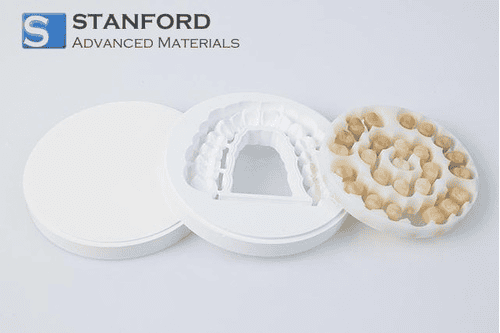
A zirconia crown is the visible restoration that replaces the outer form of a tooth. A zirconia implant is a component placed in bone to support a restoration. An implant-supported tooth can contain both, but the two parts have different shapes, surfaces, and mechanical responsibilities.
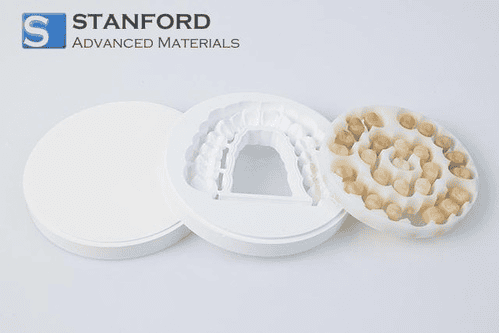
The distinction matters when discussing materials. Dental zirconia blanks intended for restorative fabrication do not, by that description alone, establish the requirements for an implant body. The same ceramic family can be processed into components whose intended uses need separate evaluation.
For readers comparing treatment terminology, separating the parts makes product descriptions easier to understand. For manufacturers and buyers, it prevents a material request from confusing a restoration, an abutment, and the structure that anchors the assembly.
What a zirconia crown has to do
A crown must reproduce a useful tooth shape, fit its supporting structure, and withstand repeated contact. Its optical appearance also matters, particularly where the restoration is visible.
Zirconia crowns can be monolithic or consist of a framework with another ceramic layered over it. These constructions have different interfaces and potential complications. A report about a veneered crown should not automatically be applied to every monolithic design.
Material selection also involves the zirconia composition. Stabilizer content and microstructure influence strength and translucency. The appropriate balance depends on the restoration and the validated material system used by the laboratory.
The fabrication route adds further requirements. Milling, sintering, and final finishing must produce the intended geometry and surface. If the restoration is adjusted after firing, the resulting surface needs the finishing process specified for that system. The material name does not describe the condition left by a grinding operation.
The implant body has a bone-facing surface
Stanford Advanced Materials (SAM) supplies ceramic materials for medical and dental development, including powder and blank options. The inquiry should name the component and the processing the buyer intends to perform.
An implant body has to function as part of a load-bearing assembly in bone. Its surface and connection geometry therefore deserve attention alongside its bulk material properties.
Ceramic implant systems include different constructions, such as one-piece and two-piece designs. The connection arrangements and available evidence differ. The German S3 guideline on ceramic implants addressed these distinctions rather than treating all zirconia systems as a single product. [1]
For a material supplier, the relevant request is the specified feedstock or component condition. The implant manufacturer defines and evaluates the resulting design, processing, surface, and assembly.
It would be misleading to infer implant suitability from the fact that a zirconia powder can be used for dental ceramics. The component needs the requirements appropriate to its particular system. This is especially relevant when a request includes a finished shape but leaves the manufacturing route undefined.
The abutment connects the two functions
The abutment is another part of the discussion. It connects the implant to the restoration, and its material may differ from the crown or implant body.
A crown described as implant-supported zirconia can therefore sit on a titanium implant. The words do not necessarily mean that the component in bone is zirconia. The supporting parts need to be identified when comparing clinical reports or discussing a proposed assembly.
A five-year randomized study of zirconia-based implant-supported crowns reported both biological and technical outcomes. Problems involving abutments and retention were part of the overall result. This shows why the behavior of the assembly cannot be reduced to the crown material alone. [2]
For procurement, a useful drawing identifies the part being supplied and its interfaces. A raw ceramic blank, a machined abutment, and a crown-forming material are different deliverables, even when zirconia appears in each description.
The distinction also helps when reviewing a quotation. Ask whether an offer covers only the ceramic material, a machined component, or an assembled part with a defined connection. Those scopes can have different inspection and manufacturing requirements.
Keeping the interface on the drawing makes later discussion more precise. A dimensional or connection issue should be described as such, rather than attributed to zirconia generally. The supplier can then review the relevant delivered feature and the device team can assess its function in the complete assembly.
Surface requirements depend on location
The crown’s contact surface, an abutment surface near soft tissue, and an implant’s bone-facing region do not have the same task. The desired finish should follow the component and its interface.
A smoother finish is not a universal answer for every region. Nor should roughness intended for one surface be copied to another. Geometry, chemistry, and processing all affect the surface presented by the finished component.
Long-term follow-up of crowns supported by zirconia implants has separately recorded issues such as chipping, roughness, and contour. Those observations belong to the investigated construction and highlight the importance of the restoration as well as its support. [3]
For a developer, this favors keeping surface specifications explicit on the drawing. If separate zones need different treatment, they should be identified before machining or finishing starts. A generic requirement for a biocompatible zirconia surface leaves too much open to interpretation.
Descriptions of outcomes need the same attention to component identity. A crown that remains in service can still need polishing, repair, or another intervention. A complication involving a restoration does not necessarily mean the implant body has failed.
Study reports may distinguish survival, success, and particular technical or biological events. The definitions should be read before a headline percentage is used in a comparison. A longer observation period can also reveal issues that an early examination did not capture.
For manufacturers, those distinctions help connect clinical observations to engineering questions. A veneering problem, a connection problem, and a bulk ceramic fracture point toward different parts of the assembly and manufacturing record.
The material inquiry should preserve that clarity. Identify which part is under review and which property needs improvement. A request for better zirconia gives the supplier much less useful information than a defined requirement for a particular component, process, and delivered condition.
Material purchasing starts with the exact component
For example, 3Y-TZP zirconia powder is a specified material family, while a disc is a processed form. Neither description should substitute for the complete requirements of a medical device.
A powder inquiry can include stabilizer content, granulation, binder condition, particle distribution, and the forming route. A blank inquiry can identify dimensions, material grade, and subsequent processing requirements. Documentation needs should be agreed alongside the supplied condition.
The practical starting question is simple: which part of the assembly is being developed? Once that is clear, the discussion can move to the material, geometry, finish, and evidence relevant to that part. It also gives healthcare readers a clearer account of what a zirconia product description actually refers to.
References
[1] German S3 guideline on the use of dental ceramic implants
[2] Five‐year randomized controlled clinical study comparing cemented and screw‐retained zirconia‐based implant‐supported single crowns
[3] Long‐Term Performance of Bi‐Layered Single Crowns Supported by Zirconia Implants: 7.5‐Year Results of a Two‐Center Prospective Cohort Study