

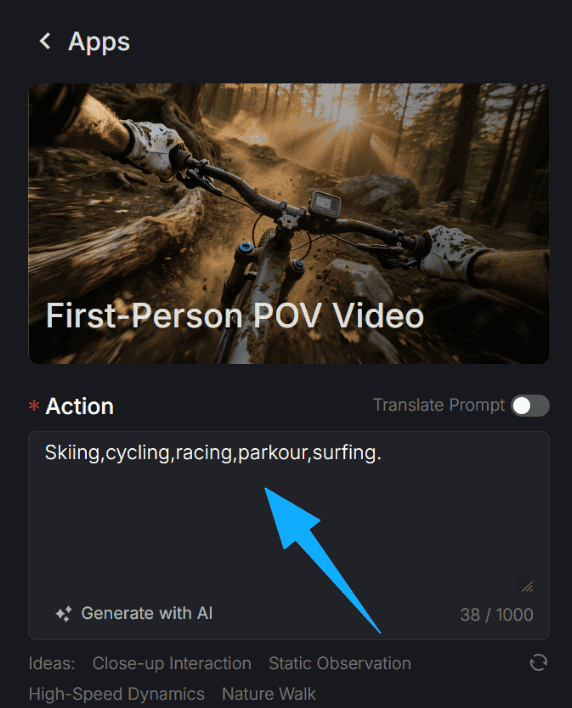
AI first-person POV videos are popular because they create instant involvement. The viewer is not observing the scene from a distance. They are inside it. But that closeness also makes mistakes more obvious.
If the camera moves unnaturally, if the environment lacks clear logic, or if the scene keeps forgetting what perspective it is supposed to have, the illusion disappears fast. A stronger way to build the format is through an Uncensored AI Video Generator workflow where perspective discipline, scene readability, and motion control are treated as the core creative problems.

1) Start With A Situation, Not Just A Setting
Many weak POV prompts describe a place but not an experience. “A futuristic city” is a setting. “Running through a futuristic city while alarms flash and people scatter” is a situation. POV works best when the viewer immediately senses:
- – where they are
- – what they are doing
- – what they should care about
The stronger the situation, the easier it becomes for motion and environment to support the story.
2) Ground The Camera In The Body
The biggest mistake in first-person video is letting the camera behave like a free-floating machine. A convincing POV shot should feel attached to a person moving through space. That means motion should be restrained and purposeful:
- – small head turns
- – natural forward movement
- – occasional focus shifts
- – believable pauses
Too much cinematic drifting breaks the illusion. The audience stops feeling “I am here” and starts feeling “a camera is flying around.”
3) Use The Environment To Tell The Story
In POV, the world does a lot of narrative work. Signs, objects, lighting changes, crowd behavior, and sound-implied action all help the viewer understand what is happening without needing constant explanation.
For example, a hospital corridor, a battlefield trench, or a backstage dressing room each suggests a very different experience. Good POV design uses those environmental cues to create orientation fast.
4) Keep The Frame Legible
Because POV content aims to feel immersive, some creators assume more detail equals better immersion. Usually the opposite is true. If the frame is too busy, the viewer loses focus and the perspective starts feeling unstable.
Stronger POV scenes usually rely on:
- – one clear forward path
- – one or two important visual details
- – intentional reveals
- – moments of stillness between movement beats
Legibility creates immersion because it allows the viewer to track experience instead of decoding visual clutter.
5) Build The Emotional Arc Into The Movement
AI first-person POV videos become more compelling when the motion reflects the emotional state of the scene. A nervous search through a hallway should move differently from a triumphant walk onto a stage. A horror reveal should not feel paced like a travel montage.
This is where direction matters. Ask what the viewer is supposed to feel in each moment:
- – curiosity
- – urgency
- – awe
- – fear
- – relief
Then let that emotional goal guide speed, framing, and progression.
6) Avoid The “Gimmick Only” Trap
First-person perspective is not enough by itself. The point of view must serve an idea. Otherwise the format becomes a novelty with no reason to continue watching.
A strong POV sequence usually has a clear arc:
1. orientation
2. escalation
3. reveal or consequence
This structure gives the perspective a narrative job rather than treating it like a visual trick.
7) Test Short Scenes Before Long Ones
Immersion is easier to judge in short blocks. Instead of building a long POV piece immediately, test 5 to 10 second scenes around one action:
- – opening a hidden door
- – entering a concert stage
- – walking through a surreal market
- – discovering a threatening clue
These mini tests reveal whether the perspective feels convincing. Once the illusion works in a short block, it is much easier to expand.
8) Make The Ending Do Something
A strong POV video should resolve into a reveal, decision, or change in emotional state. Maybe the viewer finds the secret room. Maybe they step into the spotlight. Maybe they realize the world is not what it seemed. Without that beat, the experience can feel like a camera exercise rather than a story fragment.

9) Use Still Frames As Anchors When Needed
Common Mistakes That Flatten The Idea
Creators often assume these formats need more intensity than they actually do. The result is usually overproduction: too many effects, too many scene changes, or too much movement competing for attention. In short-form or concept-driven video, that usually weakens the strongest part of the idea.
A better rule is to decide what the audience is supposed to notice first, then make everything else support that moment. If the central beat is a reveal, let the reveal breathe. If the central beat is a reaction, do not crowd it with unnecessary visual noise. Most memorable clips feel intentional because they stay loyal to one clean idea and keep the edit disciplined enough for that idea to land immediately.
Choose The Version That Lands Fastest
When you compare multiple drafts, do not ask only which one looks more polished. Ask which one lands faster. In concept-driven content, the viewer rarely rewards complexity for its own sake. They reward clarity. The strongest version is often the one that reaches the central beat earliest, frames it most cleanly, and exits before the idea becomes repetitive. That kind of editorial discipline usually matters more than adding more visuals or more motion to prove the concept is “big enough.”
Some POV concepts begin with one carefully designed composition that defines the mood and place. In those cases, a final image to video step can be a practical way to move from key frame to immersive motion while preserving the scene geometry and first-person layout you already trust.