

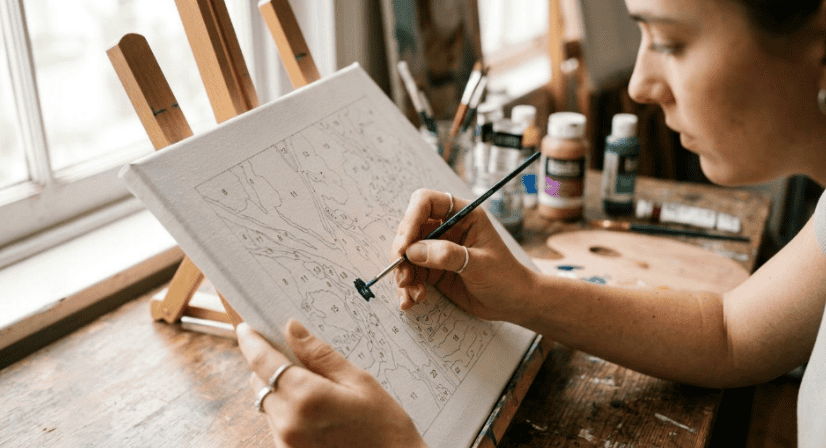
Filling in a numbered section keeps the prefrontal cortex quiet – a measurable neurological shift that psychologists link to reduced anxiety
Most adults write off creative hobbies the moment they pick up a brush and produce something that looks nothing like what they imagined. The result is a familiar loop: you decide you’re “not artistic,” and you never try again. But neuroscience has a different take. Structured creative activities produce measurable changes in brain chemistry, stress hormones, and mood – and the evidence is specific enough to be worth paying attention to.
A 2024 poll by the American Psychiatric Association found that 46% of Americans already use creative activities to relieve stress or anxiety. Adults who rate their mental health as very good or excellent engage creatively at a rate of 71% – compared to 46% for those with fair or poor mental health. The gap is significant. What most people don’t know is why creative activities work, not just that they do.
The answer is in the brain.
What Happens in Your Brain When You Paint
The psychologist Mihaly Csikszentmihalyi spent decades studying a mental state he called “flow” – a condition of full absorption where self-consciousness drops, time distorts, and performance improves. Athletes call it being “in the zone.” Csikszentmihalyi documented it across surgeons, chess players, and musicians. It also shows up when people paint.
A 2024 neuroimaging study from Drexel University’s Creativity Research Lab identified the precise mechanism. When a person reaches a flow state during creative work, activity in the frontal lobe – the brain’s cognitive control center – drops measurably.
This isn’t just relaxation; it’s an active neurological shift. The brain quiets the part responsible for judgment and self-monitoring, and the networks tied to idea generation take over. The Drexel team called it an “expert-plus-release” mechanism – proficiency in a task allows the brain to stop micromanaging and let go.
There’s also a dopamine dimension. Each time you complete a section – fill in a color, move to the next number – your brain registers a small completion signal. It’s the same reward loop that makes progress bars satisfying. Over a painting session, those signals accumulate into a genuine sense of momentum and accomplishment.
For adults looking for a low-barrier entry point into structured creative practice, it’s worth taking time to learn more about custom kits that let you paint from your own photographs – a format that combines the neuroscience of structured art with personal meaning.
It’s also worth mentioning that the full Drexel findings are available via Drexel University’s Creativity Research Lab.
The Structured Format Is the Point
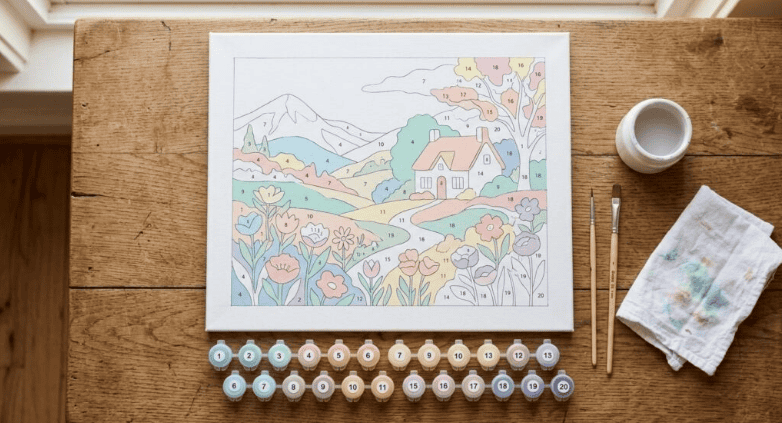
Unlike open-ended painting, numbered sections eliminate decision fatigue, making flow state accessible to anyone
Not all creative activities produce the same psychological effect. This is the part that competitors writing about paint-by-numbers consistently miss.
Open-ended painting is cognitively demanding for beginners. Every brushstroke requires a decision: which color? How dark? Where does this shape end? For someone without years of training, those constant micro-decisions create anxiety, not flow. The blank canvas becomes a source of pressure rather than freedom.
Paint by numbers removes that burden entirely. The numbered regions pre-assign colors to sections. The composition is already determined. What’s left is the meditative act of filling, matching, and completing. That structure isn’t a limitation – it’s the neurological key that makes flow accessible to people who have never touched a brush in their adult life.
A 2025 study published in SAGE Journals, examining art students’ lived experience of flow, confirmed that clear goals and reduced distraction are what allow flow state to emerge in creative work. Structured goal focus directly reduces anxiety by lowering self-consciousness during the process. Remove the freehand decisions, and you remove one of the main barriers to absorption.
The long-term data backs this up. A 2025 scoping review published in Issues in Mental Health Nursing (Taylor & Francis) tracked older adults over 12 years and found that those who took up a hobby increased their odds of recovering from depression by 272%. Those who weren’t depressed at the start reduced their risk of developing it by 32%. Hobby engagement – consistent, structured, absorbing – is doing something real in the brain.
A 2024 meta-analysis in JAMA Network Open, reviewing 69 studies with nearly 4,200 participants aged 4 to 96, found that visual art therapy was associated with meaningful improvements across mental health outcomes, including depression, anxiety, self-esteem, and quality of life.
Self-Expression Without the Blank Canvas Anxiety
The single biggest psychological barrier to creative activity isn’t lack of time. It’s the belief that you don’t have enough talent to justify trying.
This belief is common, and it’s also wrong in a specific way. The mental health benefits of creative activity don’t come from producing a masterpiece. They come from the process itself. Daisy Fancourt, a professor at University College London who studies arts and health, has argued in Psychology Today (February 2026) that just 15 to 20 minutes of focused creative activity several times a week is enough to produce measurable wellbeing effects – regardless of skill level.
This is the same avoidance pattern that shows up in other areas of health. The psychology of avoidance operates the same way whether someone is postponing a doctor’s appointment or dismissing creative hobbies as “not for me.” The perceived cost of failure outweighs the anticipated benefit, so people opt out entirely.
Paint-by-numbers sidesteps this by making success structurally inevitable. You can’t produce something completely wrong when the process itself guides you. That built-in guarantee of completion removes the avoidance trigger before it activates.
Why Custom Kits Add an Extra Layer of Meaning
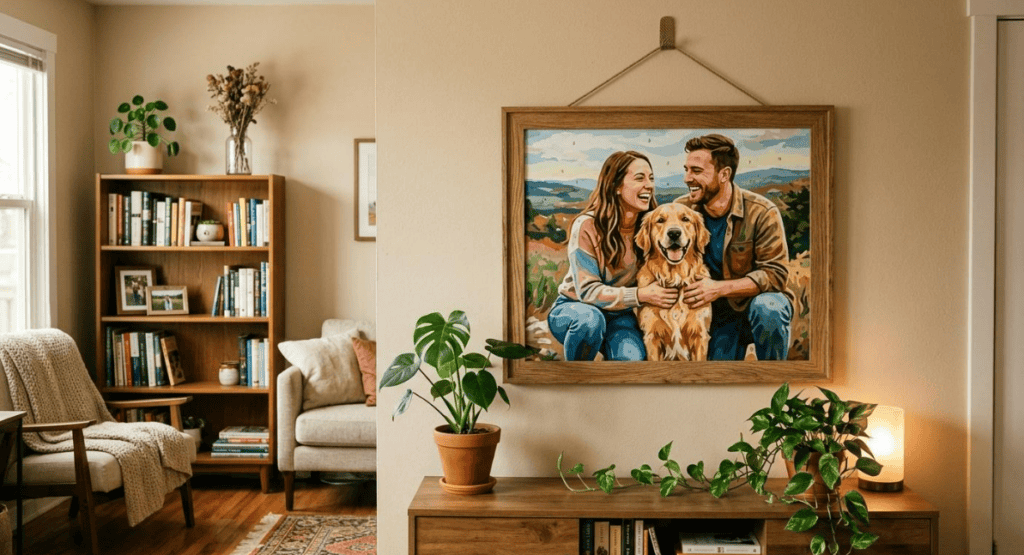
Painting from a personal photo adds emotional resonance to the process, deepening the psychological benefit of completion
Standard paint-by-numbers kits offer the neurological benefits of structured creativity. Custom kits go further.
When you paint from a photograph that means something to you – a family trip, a child’s face, a dog you’ve had for years – the creative process connects to memory, identity, and emotion in ways that a generic landscape doesn’t. Research on arts engagement and psychological flourishing, published in PMC in 2024, found that arts activities allow people to explore and express identity themes – a dimension of creative work that contributes to psychological wellbeing beyond simple stress relief.
The act of recreating a personal memory through a structured medium does two things simultaneously. It gives you the neurological benefits of flow state and dopamine completion. And it asks you to sit with something meaningful, slowly, section by section – which is a form of emotional processing through creative work that passive entertainment can’t replicate.
There’s also a practical dimension that’s easy to underestimate. Paint-by-numbers is a screen-free activity. That matters more than it sounds. The anxiety that comes from constant digital consumption – the scroll loop, the notification pull, the ambient low-grade stress of being always online – doesn’t disappear on its own. A focused analog activity interrupts it. For more on how digital communication and mental wellbeing interact, the research is consistent: deliberate disconnection from screens supports psychological recovery in ways that simply “putting the phone down” without a replacement activity doesn’t.
Creativity Is a Mental Health Tool, Not a Luxury
The evidence from these studies points in one direction: structured creative activity affects the brain in specific, documented ways. Flow state reduces frontal lobe activity and anxiety. Dopamine signals build a sense of accomplishment. Hobby engagement correlates with lower rates of depression over time. And 15 to 20 minutes is enough – you don’t need to clear a Saturday.
Paint by numbers is particularly well-positioned for adults who’ve convinced themselves they’re not creative. The structure handles the decisions that cause anxiety in beginners. The numbered format makes flow accessible without requiring years of practice. And when the kit uses a photo that carries personal meaning, the finished painting carries emotional weight that the process of making it has already begun to work through.
That’s not a children’s hobby. That’s a research-backed psychological practice that’s also enjoyable.